|
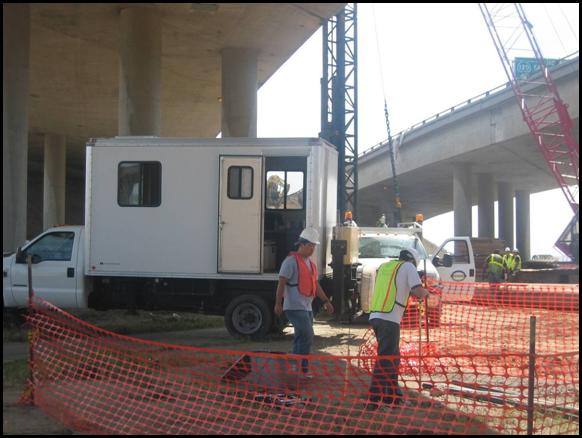
UCLA Engineers Monitor Construction Vibrations at Archeological Site The California Department of Transportation is widening a section of I-5 that traverses a shallow-buried prehistoric archeological site in northern California. Construction operations to widen the bridge include installation of steel pipe piles that are driven into the ground to support the mass of the bridge, involving the use of heavy equipment. Caltrans was concerned that construction operations could change the stratigraphic relations of the soil layers at the site. A primary concern in archeological study is the stratigraphic context in which the artifacts exist. The geologic history of the soil layers carries with it the history of the artifacts, and artifacts removed from their stratigraphic context cannot be properly interpreted. On April 30th through May 2nd, the nees@UCLA (www.nees.ucla.edu) team deployed their state-of-the-art equipment to monitor vibrations induced by construction operations at the archeological site. Professor Scott Brandenberg, operations manager Bob Nigbor, and a team of researchers deployed high-resolution vibration sensors on the ground surface and at the bottom of boreholes to depths of 5 meters to measure the levels of ground vibrations due to pile driving operations. The nees@UCLA cone penetration rig was deployed to measure soil profiles before, during, and after construction operations. This data provides a rational means for estimating whether construction operations caused changes in the soil layers, and if so, the distance and depth to which the influence extended. The innovative work performed by nees@UCLA constitutes a change in the approach taken to protect archeological sites. In past similar situations, the artifacts were buried under a layer of fill during construction operations based on the assumption that preventing direct contact with construction equipment protects soil layers. However, the nees@UCLA team showed that construction vibrations can extend deep into the ground, potentially disrupting buried soil layers. The data is currently being interpreted to assess the impact of the ground vibrations on changes in soil stratigraphy. The US National Science Foundation (NSF) has established the George E. Brown, Jr. Network for Earthquake Engineering Simulation (NEES) as a national, networked collaboratory of geographically-distributed, shared-use experimental research equipment sites. nees@UCLA is an equipment site specializing in field testing and monitoring of structural performance. As a part of this program, the UCLA NEES program has developed a state-of-the-art mobile field laboratory to enable detailed, seismic performance characterization of full-scale structural and foundation systems. Through use of this equipment, it is possible to develop an inventory of field test results that provide significant new insights into the nonlinear response of full-scale structural systems, as well as soil structure interaction effects. |